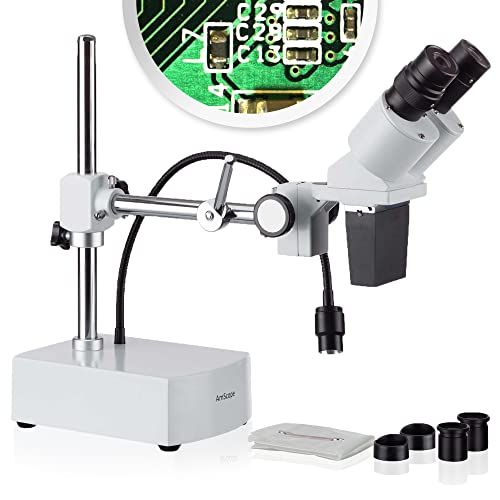
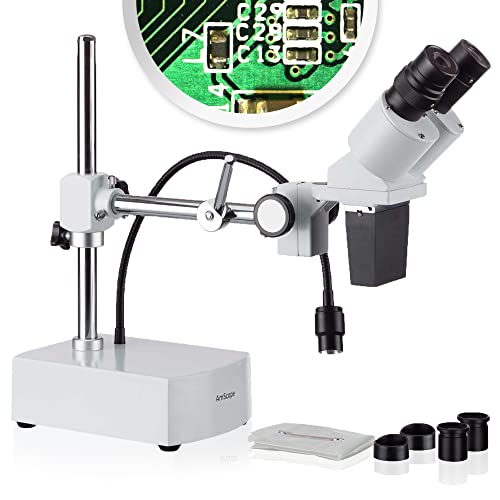
AmScope SE400-Z
A true stereo microscope with unusually generous working distance. Excellent for hands-on repair where depth perception matters more than headline magnification.
Best for: Soldering, jewelry, inspection and repair
Check current price on AmazonAmazon prices and availability change frequently. The button opens the exact model listing; qualifying purchases may earn ScopePilot a commission.
Key specifications
- 10x and 20x stereo magnification
- 9-inch working distance
- Binocular stereo head
- Boom arm and LED gooseneck light
Pros
- True depth perception
- Very large working distance
- Strong repair-work ergonomics
Fit considerations
- Two fixed optical magnification levels
- No dedicated camera port; an eyepiece camera replaces one eyepiece
Who should buy it?
AmScope SE400-Z makes the most sense for soldering, jewelry, inspection and repair. It is not ranked purely on advertised magnification; ScopePilot gives more weight to optical type, working distance, ergonomics, camera workflow and the kind of specimen being viewed.
More product photos
AmScope SE400-Z: ScopePilot overview
A true stereo microscope with unusually generous working distance. Excellent for hands-on repair where depth perception matters more than headline magnification.
Soldering, jewelry, inspection and repair
Bottom lineTrue depth perception A useful fit note is fixed optical powers.
Detailed specifications
10x and 20x stereo magnification
9-inch working distance
Binocular stereo head
Boom arm and LED gooseneck light
45° inclined binocular stereo head
10× and 20× eyepiece pairs with 1× objective
30.5mm ocular tubes
±5 diopter adjustment
50–77mm interpupillary range
9-inch (228mm) working distance
12-inch boom arm with steel base
Gooseneck LED illumination; confirm the regional bundle
What the design means for bench work
The unusually long working distance and real stereo depth make this one of the most practical entry-level choices for soldering, assembly and jewelry work. Fixed 10×/20× powers are simple but less flexible than continuous zoom.
What it does well
- True depth perception
- Very large working distance
- Strong repair-work ergonomics
Fit considerations and buying checks
- Two fixed optical magnification levels
- No dedicated camera port; an eyepiece camera replaces one eyepiece
- There is no dedicated camera port, built-in recording or continuous zoom. A compatible eyepiece camera can replace one eyepiece, which interrupts normal binocular viewing. For frequent capture while working, compare a trinocular stereo microscope and confirm its camera-path behaviour.
Setup, workflow and compatibility
Set interpupillary distance first, focus one eye, then balance the diopter. Position the oblique gooseneck light to make low-contrast component markings visible.
Who should buy it?
Choose the AmScope SE400-Z when your main work is soldering, jewelry, inspection and repair and the specifications above match your intended specimen, workspace and capture method. Buyers should confirm the exact current bundle, included accessories, voltage, software support and return terms before ordering.
ScopePilot verdict
The AmScope SE400-Z is strongest when judged within its own microscope category rather than by its largest advertised magnification number. Its practical value comes from the combination of optics or sensor, working distance, stand stability, illumination and viewing comfort described above.
SE400-Z buying checks for soldering and repair
This is a research-based assessment of published specifications, not a hands-on optical or repair-speed test. The useful question is whether the fixed powers, viewing position and capture workflow fit your actual bench.
| Your work | Why the SE400-Z may fit | Reason to compare another type |
|---|---|---|
| Moving tools around a circuit board | Published 9-inch working distance provides substantial clearance below the optics. | Check where the stand base, fume extraction and board holder sit together. Optical clearance does not measure your complete workspace. |
| Inspecting different component sizes | 10× and 20× powers cover two fixed views. | Changing power means swapping eyepiece pairs. Compare stereo zoom if you frequently alternate between overview and detail. |
| Taking occasional pictures | The maker describes camera use in place of an eyepiece. | Confirm a suitable 30.5 mm adapter, camera coverage and computer compatibility. An eyepiece camera is not included by default. |
| Recording while repairing | Binocular viewing provides a direct stereo view for the operator. | A trinocular stereo model offers a separate camera route; a digital screen system offers another workflow. Check view switching and latency on the exact model. |
Ask the seller to demonstrate these three things
- View a representative board at both powers with your intended holder and tools in position. Check comfortable posture, reachable focus and clearance.
- Move the gooseneck light across reflective solder joints and component markings. Decide whether your tasks require additional diffuse illumination.
- If you need documentation, ask for an image from the exact camera and adapter combination and confirmation of what happens to binocular viewing.
What the complete setup costs
Compare the delivered microscope, any required illumination or camera adapter, and the return destination. The manufacturer's US listing specifies 110 V / 60 Hz; confirm the exact regional unit before importing. Camera, monitor and computer requirements depend on your chosen capture route.
Continue with the soldering microscope comparison, digital versus stereo guide and camera connection guide. For a dedicated photo tube, compare the AmScope SW-3T24Z stereo model.
Primary reference checked 10 September 2026: AmScope SE400-Z manufacturer specification and camera notes. We do not infer measured resolution, stability or long-session comfort from a specification sheet.